Midnight in the Garden of Good and Evil: A Savannah Reader's Guide to the Book
By Best of Savannah
As an Amazon Associate we earn from qualifying purchases. See our affiliate disclosure. Book facts below were checked October 23, 2026.
Prefer to listen? Start an Audible free trial (for eligible new members) and use it on one of the books below.
The short answer
Midnight in the Garden of Good and Evil is John Berendt’s nonfiction book about Savannah, published by Random House in January 1994. The New Georgia Encyclopedia says locals quickly took to calling it “The Book.” The spine of the story is a 1981 shooting at the house of antiques dealer Jim Williams. Around that case, Berendt wrote the people he met in the city.
The encyclopedia’s article, by Carl Solana Weeks, was first published July 10, 2002, and last edited January 16, 2019. As of that edit it describes more than three million copies, a Southern Book Award, a place as a Pulitzer Prize nonfiction finalist, and 216 weeks on the New York Times best-seller list. Those are the encyclopedia’s figures, not a new sales count for 2026. The Pulitzer finalist page for John Berendt is the official listing to check beside it.
This page is about the book: what it is, how much of it is true, which editions exist, and what else to read. Filming locations for the 1997 movie belong to our movies filmed in Savannah guide.
A spoiler-light summary
Berendt arrived in a city that already had its own rules about who talked to whom. The New Georgia Encyclopedia says the book is built loosely around the May 1981 shooting of Danny Hansford by Jim Williams, and around the trials that followed. The opening chapters are more interested in parties, gossip, and who pours the drink than in a verdict. That verdict is in the next section, so you can stop here if you want to meet the people first.
Williams lived in the Mercer House, the mansion on Monterey Square that visitors still come to see. The book’s Savannah also includes singer and pianist Emma Kelly, whom Johnny Mercer called “The Lady of 6,000 Songs”; Joe Odom, a lawyer whose charm outran his checks; an inventor the book names Luther Driggers; Minerva, the Lowcountry root doctor the book shows working spells for Williams; and Sonny Seiler, Williams’s defense attorney and an owner of Uga, the University of Georgia bulldog. Those portraits are the encyclopedia’s account of the book, not a police report.
The person many readers remember is The Lady Chablis. The encyclopedia’s article on her says she found a national audience when the book came out in January 1994, later played herself in the film, and published her own story two years after Berendt’s book. Open Library lists the 1997 Pocket Books paperback of Hiding My Candy, subtitled “The Autobiography of the Grand Empress of Savannah,” under Lady Chablis, Theodore Bouloukos, and John Berendt. See Hiding My Candy on Amazon
Is it a true story?
Yes, with limits he stated. The New Georgia Encyclopedia calls the book a nonfiction narrative. Williams was accused of killing Hansford, stood trial four times over more than eight years, and was acquitted. That is the public outcome the encyclopedia records. It is one sentence, and it is not the reason most people finish the book.
Berendt also warned readers that the clock in the story is not a court transcript. Roy Peter Clark, in “The Line Between Fact and Fiction” (Poynter, July 30, 2002), quotes the author’s note:
Though this is a work of nonfiction, I have taken certain storytelling liberties, particularly having to do with the time of events. Where the narrative strays from strict nonfiction, my intention has been to remain faithful to the characters and to the essential drift of events as they really happened.
Read it as reported nonfiction that rearranges time, not as a novel and not as a trial transcript. If a tour script adds a detail this page does not, ask where it came from.
Who wrote the book?
John Berendt. The New Georgia Encyclopedia says he was born in 1939 and grew up in Syracuse, New York. He wrote and edited for the Harvard Lampoon, then worked as an associate editor at Esquire and as editor of New York magazine. He moved to Savannah in 1985 to research the book, took an apartment, and for eight years lived in the city off and on, interviewing people and gathering material.
Random House published the book in January 1994. The same encyclopedia article says it won the Southern Book Award and was a finalist for the Pulitzer Prize in nonfiction. For the wider city story around the book, see our Savannah history facts.
Which edition to buy
Print links in this section and in the reading list use the ISBN-10 that Open Library lists for that title and author, checked October 23, 2026. On a product page, confirm the publisher and the author before you buy. Kindle and audiobook links are searches. This page does not claim a specific seller, a stock count, or a price.
- Vintage paperback. Open Library lists ISBN-10 0679751521 as the Vintage paperback of June 28, 1999, 400 pages. Penguin Random House’s book page dates that paperback the same day. See the Vintage paperback on Amazon
- 1994 Random House edition. Open Library lists ISBN-10 0679429220 as the 1994 Random House edition, subtitle “a Savannah story,” 388 pages, and does not set a format. Penguin Random House lists a hardcover with that ISBN, published January 13, 1994. See the 1994 Random House edition on Amazon
- Modern Library hardcover. Open Library lists ISBN-10 0679643419 as a Modern Library hardcover of September 27, 2005, 416 pages. It is a later hardcover. It is not labeled an anniversary edition on that record. See the Modern Library hardcover on Amazon
- Kindle. Penguin Random House lists an ebook dated May 12, 2010. The link here is an Amazon search, not a Kindle product code this page has verified. Search Kindle editions on Amazon
- Audiobook. Penguin Random House lists an audiobook download with an on-sale date of November 22, 2005. The link here is a search. It is not a statement that a given edition is in the Audible catalog. Search audiobook editions on Amazon
The Bird Girl statue
The cover photograph is not the book, and the statue is no longer where Jack Leigh found her. In “On the Trail of the Bird Girl” (Telfair Museums, April 15, 2019), Harry DeLorme, Senior Curator of Education, writes that Sylvia Shaw Judson sculpted the figure in clay in 1936 and that it was cast six times. It was shown in 1938 as Fountain Figure, a garden sculpture, and was not called Bird Girl until a 1967 book. Leigh photographed her at Bonaventure in 1993 for the dust jacket. Her pose, bowls held out, can look like the scales of justice. DeLorme credits Sandra Lee Underwood’s book for the path to Savannah: Lucy Boyd Trosdal wanted a sculpture for the family plot, and the figure was installed there around 1940.
After the book, crowds overwhelmed the Trosdal lot. The statue was removed. DeLorme writes that since 1997 she has been on loan to Telfair Museums, first at the Telfair Academy, then at the Jepson Center, and back at the Academy for the exhibition. Before Midnight: Bonaventure and the Bird Girl was at the Telfair Academy, 121 Barnard Street, from April 12, 2019 through March 22, 2026. That end date has passed. This page does not guess which gallery she is in today. Check telfair.org before you promise someone a room number. She is not back at Bonaventure.
Underwood’s book is in the history list below. The cemetery she left is in our Bonaventure Cemetery guide and on the Bonaventure cemetery tours page.
Seeing the house and the cemetery
Mercer House is a private house museum, not a film-location checklist. The museum’s about page says New York architect John S. Norris designed it for General Hugh W. Mercer, great-grandfather of songwriter Johnny Mercer. Construction began in 1860, stopped for the Civil War, and finished in 1868 after Mercer sold the unfinished house to John R. Wilder. No Mercer ever lived there. Jim Williams bought it in 1969 and restored it. The museum’s home page lists the house at 429 Bull Street. The entrance for tours is behind the house at 430 Whitaker Street. On October 23, 2026 the hours were Monday through Saturday, 10:00 a.m. to 5:00 p.m. (first tour 10:30 a.m., last tour 4:10 p.m.), and Sunday, 11:30 a.m. to 5:00 p.m. (first tour noon, last tour 4:00 p.m.), with tours about every 20 to 40 minutes. The visit page says the guided tour is about 35 minutes, first come, first served, and that the house is not licensed as handicap accessible. Parties of six or more can call 912-236-6352 or 912-238-0208. Confirm the day you go.
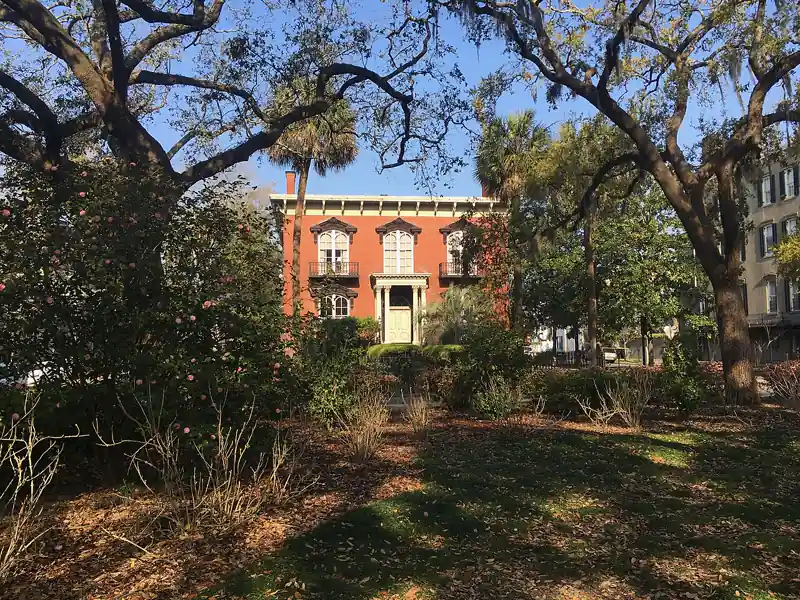
Monterey Square is the square in front of that view. The New Georgia Encyclopedia says filming began on the square on May 5, 1997, and that several scenes were shot at the house. A walk around the square is enough if you only want to see the facade. Breakfast nearby is an easy add-on; Clary’s Cafe is in our restaurant directory. For where else the movie used the city, use the movies guide rather than this page.
Bonaventure Cemetery is where Leigh made the cover photograph, and it is not where Bird Girl stands now. The City of Savannah cemetery page puts the entrance at 330 Bonaventure Road, Savannah, GA 31404, on a bluff of the Wilmington River. The site was a plantation, became a private cemetery in 1846, and a public one in 1907. It is the largest municipal cemetery, over 100 acres, and it is open daily from 8:00 a.m. to 5:00 p.m. Our haunted places guide covers the cemetery with the rest of the city’s ghost lore, and Bonaventure tours are the way to go with a guide.
This post contains affiliate links. See our affiliate disclosure.

The 1997 film
Clint Eastwood’s film is one paragraph here, because the book is the subject. The New Georgia Encyclopedia says Warner Bros. bought the rights, John Lee Hancock wrote the script, and Eastwood had not read the book when Hancock showed it to him. Shooting began May 5, 1997, on Monterey Square. Kevin Spacey played Williams, John Cusack played a renamed Berendt (John Kelso), and The Lady Chablis played herself. The movie premiered at Savannah’s Johnny Mercer Theater on November 20, 1997, and opened nationwide the next day. Scenes were filmed at Mercer House. For the rest of the locations, read movies filmed in Savannah.
What to give a Midnight reader
Give the book, then a way to hear it, then a history that is not the same story. The Vintage paperback is the usual print gift. See the Vintage paperback on Amazon For a long drive, use the audiobook search rather than guessing a catalog listing. Search audiobook editions on Amazon Walter J. Fraser’s Savannah in the Old South is the history title if they want the city before Williams. See it on Amazon A jar instead of a book is a different gift: our Savannah Bee Company honey guide covers tupelo and the Broughton Street shop.
Midnight in the Garden of Good and Evil book FAQ
Is Midnight in the Garden of Good and Evil a true story?
The New Georgia Encyclopedia calls it a nonfiction narrative built around the May 1981 shooting of Danny Hansford by antiques dealer Jim Williams, four trials over more than eight years, and Williams’s acquittal. In the author’s note, quoted by Roy Peter Clark at Poynter in 2002, Berendt wrote that he took storytelling liberties, particularly with the time of events, while aiming to stay faithful to the characters and to the essential drift of events. Checked October 23, 2026.
Where is the Bird Girl statue now?
She is not at Bonaventure Cemetery. Telfair Museums says that since 1997 she has been on loan to the museum, and that a 2019 exhibition put her back at the Telfair Academy. That exhibition, Before Midnight: Bonaventure and the Bird Girl, ran April 12, 2019 through March 22, 2026. That end date has passed. Check telfair.org for where she is on view now. Checked October 23, 2026.
Can you tour Mercer House?
Yes. The Mercer Williams House Museum lists tours Monday through Saturday, 10:00 a.m. to 5:00 p.m., first tour 10:30 a.m. and last tour 4:10 p.m., and Sunday, 11:30 a.m. to 5:00 p.m., first tour noon and last tour 4:00 p.m. The entrance is behind the house at 430 Whitaker Street. Tours are about 35 minutes, first come, first served, and the house is not licensed as handicap accessible. Parties of six or more can call 912-236-6352 or 912-238-0208. Checked October 23, 2026.
Is the book better than the movie?
This page does not rank them. The book is John Berendt’s 1994 nonfiction narrative. The film is Clint Eastwood’s 1997 adaptation, covered in our movies filmed in Savannah guide. Read the book for the people and the author’s note. Use the film guide for shooting locations.
Who wrote Midnight in the Garden of Good and Evil?
John Berendt. The New Georgia Encyclopedia says he was born in 1939, grew up in Syracuse, New York, wrote for the Harvard Lampoon, was an associate editor at Esquire and editor of New York magazine, and moved to Savannah in 1985. He lived in the city off and on for eight years while reporting the book. Random House published it in January 1994.
Is there an audiobook?
Penguin Random House’s book page lists an audiobook download with an on-sale date of November 22, 2005, along with the print editions. The Amazon link on this page is a search, not a confirmed product code. This page does not confirm that any specific title is in the Audible catalog. Checked October 23, 2026.
What is Midnight in the Garden of Good and Evil about?
It is John Berendt’s nonfiction book about Savannah, published by Random House in January 1994. The spine of the story is the May 1981 shooting of Danny Hansford at the house of antiques dealer Jim Williams, and the people Berendt met in the city around that case. Locals took to calling it The Book. The verdict is in the true-story section above, not in this short answer.
More books about Savannah
The list below is books only. Each print link is the ISBN-10 Open Library lists for that title and author, checked October 23, 2026. Confirm the publisher and the author on the product page. Nothing here is a price, a star rating, or a claim that a title is in the Audible catalog.
Savannah history
These are histories of the city. They are not sequels to Berendt, and they do not try to settle the Williams case.
- Savannah in the Old South, by Walter J. Fraser. University of Georgia Press, 2003, 423 pages. A narrative history of the city before the late twentieth century, separate from the Williams case. See it on Amazon
- Saving Savannah, by Jacqueline Jones. Alfred A. Knopf, 2008, 510 pages. The subtitle on the Open Library record is “the city and the Civil War.” See it on Amazon
- Slavery and Freedom in Savannah, by Leslie M. Harris, Daina Ramey Berry, and Jonathan M. Bryant. University of Georgia Press, 2014, 288 pages. Open Library lists those three names on this edition. See it on Amazon
- The Weeping Time, by Anne C. Bailey. Cambridge University Press, 2017. The subtitle is “memory and the largest slave auction in American history.” Cambridge’s chapter 1 says that on March 2 and 3, 1859, Pierce Mease Butler sold 436 men, women, and children at the Savannah Tenbroeck Racetrack. See it on Amazon
- Civil War Savannah, by Derek Smith. Frederic C. Beil, 1997, 305 pages. A Civil War history of the city, not a retelling of the 1981 case. See it on Amazon
- Savannah, 1733 to 2000, photographs from the Georgia Historical Society. Open Library dates an Arcadia Publishing edition to 2001 and lists Susan E. Dick, Mandi D. Johnson, and the Georgia Historical Society. The subtitle is “Photographs from the Collection of the Georgia Historical Society.” Confirm the printing on the product page. See it on Amazon
- The Bird Girl, by Sandra Lee Underwood. Schiffer Publishing, 2006, 160 pages. The subtitle is “the story of a sculpture by Sylvia Shaw Judson.” Telfair curator Harry DeLorme pointed readers to this book in 2019. See it on Amazon
Flannery O'Connor
O’Connor was born in Savannah. The novels and stories below are her work, not novels set on these squares. The childhood-home site says Mary Flannery O’Connor was born in Savannah on March 25, 1925, and that the family moved to Atlanta in 1938, then to Milledgeville the next year. The visit page puts the house at 207 East Charlton Street, on Lafayette Square, open Thursday through Sunday from 10 a.m. to 5 p.m., with guided tours at 11 a.m., 1 p.m., and 3 p.m. That page also posts holiday closures. Checked October 23, 2026.
- The Complete Stories, by Flannery O'Connor. Farrar, Straus and Giroux, 1973, hardcover, 555 pages. Her stories, not a novel set in Savannah. See it on Amazon
- Wise Blood, by Flannery O'Connor. This Open Library record is a Farrar, Straus and Giroux edition dated January 1, 1990, 232 pages, subtitled “A Novel.” The childhood-home site dates the novel to 1952. It is not a Savannah novel. See it on Amazon
- The Habit of Being, letters of Flannery O'Connor. Farrar, Straus and Giroux, 1988, 617 pages. Open Library subtitles this edition “letters” and lists O’Connor as the author. See it on Amazon
- Flannery: A Life of Flannery O'Connor, by Brad Gooch. Little, Brown and Company, 2008, 448 pages. A biography, so the Savannah childhood is part of a longer life. See it on Amazon
Ghost stories and haunted Savannah
Read these as ghost stories. For the squares, cemeteries, and hotels visitors ask about, use our haunted places in Savannah guide and the ghost tours directory.
- Haunted Savannah, by James Caskey. A 2005 paperback, 205 pages. The subtitle is “The Official Guidebook to Savannah Haunted History Tour.” These are the book’s stories, not a ruling that a site is haunted. See it on Amazon
- Savannah Spectres and Other Strange Tales, by Margaret Wayt DeBolt. Donning, 1984, 295 pages. A collection of strange tales. Read it as storytelling, not as a verified haunting. See it on Amazon
Girl Scouts and Juliette Gordon Low
Girl Scouts of the USA says Juliette Gordon Low organized the first troop on March 12, 1912, in Savannah. The house museum is covered in our Juliette Gordon Low Birthplace guide.
- Juliette Gordon Low, by Stacy A. Cordery. Viking, 2012, hardcover, 328 pages. The subtitle is “the remarkable founder of the Girl Scouts.” See it on Amazon
- First Girl Scout, by Ginger Wadsworth. Clarion Books, 2012. The subtitle is “the life of Juliette Gordon Low.” See it on Amazon
- Here Come the Girl Scouts!, by Shana Corey. Scholastic Press, 2012, by Shana Corey. Open Library lists the title and does not add a reading level. See it on Amazon
Novels set in Savannah
John Jakes’s book is subtitled a novel. The Andrews titles and Eugenia Price’s Savannah are listed because Open Library files them under those authors and titles. This page does not invent their plots.
- Savannah Blues, by Mary Kay Andrews. HarperCollins, 2002. Open Library lists the title and author and does not summarize the plot. Read the publisher’s description before treating it as a Savannah novel. See it on Amazon
- Savannah Breeze, by Mary Kay Andrews. Harper Paperbacks, January 30, 2007, 448 pages. A later Andrews title. This page does not retell the story. See it on Amazon
- Savannah, or, A Gift for Mr. Lincoln, by John Jakes. Dutton, 2004, 288 pages. Open Library subtitles it “a novel.” The title points at the December 1864 message to President Lincoln, which our Savannah history facts guide covers. See it on Amazon
- Savannah, by Eugenia Price. Doubleday, 1983, hardcover, 595 pages. Open Library does not label this edition a novel. Confirm the description on the product page. See it on Amazon
Guidebooks
Useful for the shape of a trip. Hours, menus, and ticket details in a 2014 or 2017 guidebook should be checked again.
- Moon Charleston and Savannah, by Jim Morekis. Avalon Publishing, 2014. The title covers Charleston and Savannah. A guidebook this old will be stale on hours and prices. Use it for layout, then check current sources. See it on Amazon
- 100 Things to Do in Savannah Before You Die, by Zach Powers. Reedy Press, August 15, 2017, paperback, 160 pages. A list book. Treat the practical details as dated. See it on Amazon
Prefer to listen? Start an Audible free trial (for eligible new members) and use it on one of the books above.


