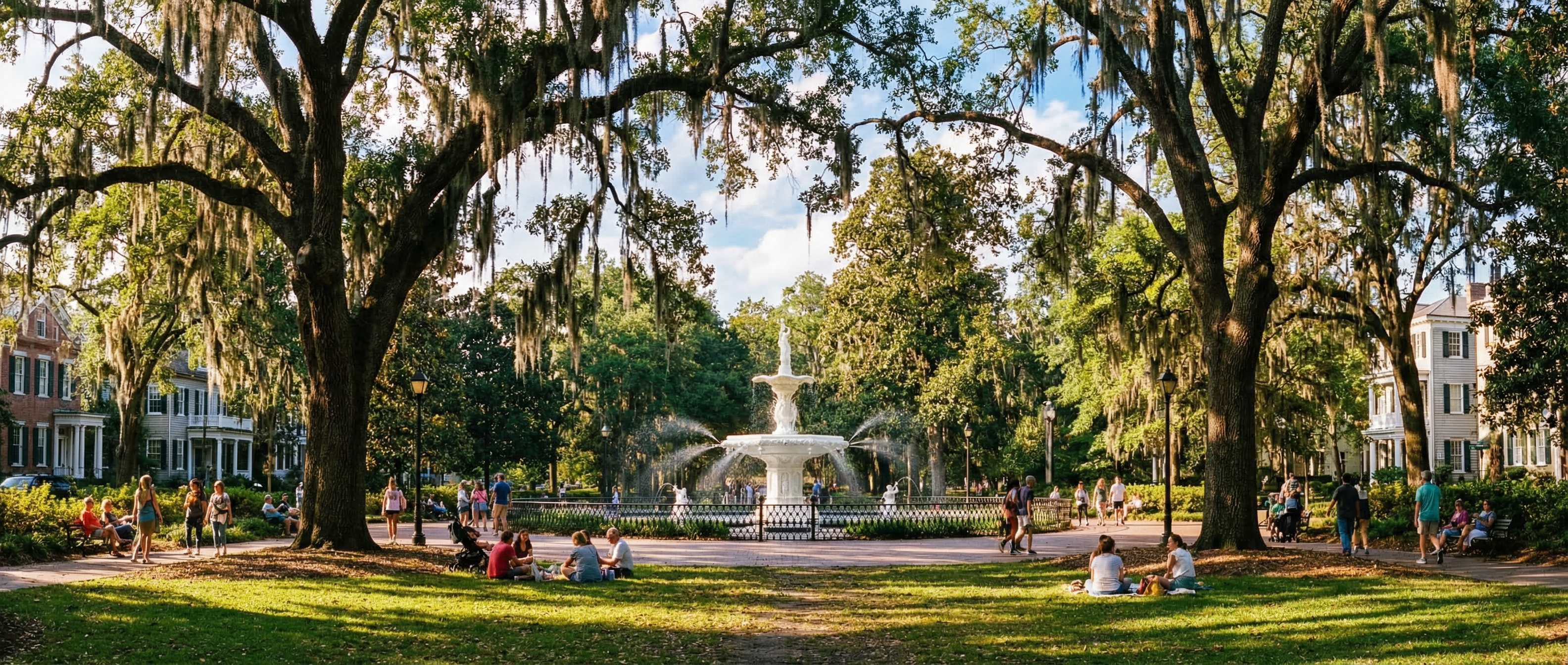
What are the best things to do in Savannah? Start with Forsyth Park and its iconic fountain (30 acres of Spanish moss and live oaks in the heart of the Historic District), walk the 22 historic squares designed in 1733, book a ghost tour through America's most haunted city, eat at Mrs. Wilkes' Dining Room or other top Savannah restaurants, explore River Street's cobblestone waterfront lined with shops and bars, take a day trip to Tybee Island (18 miles east for beaches and seafood), visit Wormsloe Historic Site for that famous oak-lined avenue, and immerse yourself in the city's art scene at galleries and museums. The best part? Savannah's Historic District is compact and walkable — most major attractions are within a 20-minute stroll. Whether you're here for history, food, nightlife, or Southern charm, Savannah delivers. This guide covers everything worth doing in 2026.
Forsyth Park: The Heart of Savannah
If you only visit one place in Savannah, make it Forsyth Park. This 30-acre green space anchors the southern end of the Historic District and serves as the city's living room — locals jog here at dawn, families picnic under centuries-old live oaks, street musicians perform near the fountain, and tourists photograph the iconic white cast-iron fountain (modeled after Paris's Place de la Concorde fountains in 1858).
The park's fountain is Savannah's most photographed landmark. It's beautiful at any hour, but visit at sunrise or just before sunset for the best light and fewer crowds. The fountain area often features local artisans selling paintings, jewelry, and crafts — a genuine Savannah experience, not a tourist trap.
What to do at Forsyth Park:
- Walk the perimeter path (1.3 miles) lined with Spanish moss-draped oaks
- Attend free concerts and festivals at the outdoor amphitheater throughout the year
- Play sports — tennis courts, basketball courts, and open lawns for frisbee/soccer
- Explore the Fragrant Garden on the park's south end (designed for the visually impaired but enjoyed by everyone)
- Grab coffee nearby at The Sentient Bean (just across from the park's south entrance)
The Victorian District borders Forsyth Park's southern and western edges — take a walk along the perimeter to see beautifully restored 19th-century homes that showcase Savannah's architectural wealth. It's free, gorgeous, and quintessentially Savannah.
Local tip: Forsyth Park is where Savannah comes to breathe. Don't rush through for a quick fountain photo. Bring a book, sit on a bench under the oaks, and watch the city go by. That's when you understand why people fall in love with Savannah.
Walk the 22 Historic Squares
Savannah's 22 historic squares are the city's defining feature. General James Oglethorpe designed the original layout in 1733 with residential blocks organized around public squares — a revolutionary urban planning concept that made Savannah one of America's first "planned cities." Today, 22 of the original 24 squares remain, each with its own character, monuments, and shaded benches.
The squares aren't just pretty — they're functional green spaces that slow down the pace of the city. You can't drive through Savannah in a straight line; you're constantly navigating around squares, which forces everyone (even locals) to slow down and notice their surroundings.
Must-See Squares
Chippewa Square: Made famous by Forrest Gump (the bench scene was filmed here, though the actual bench is now in a museum). The statue of General Oglethorpe stands in the center, and the square is surrounded by beautiful townhouses. It's centrally located and photogenic — expect crowds.
Monterey Square: Often called Savannah's most beautiful square. Mercer-Williams House (of Midnight in the Garden of Good and Evil fame) faces the square's western side. The fountain and live oaks here are stunning, and it's slightly less touristy than Chippewa.
Madison Square: Home to the Green-Meldrim House (Sherman's headquarters during the Civil War) and surrounded by some of Savannah's finest examples of Greek Revival and Gothic Revival architecture. Quieter than the tourist-heavy squares, but equally beautiful.
Reynolds Square: Named after Georgia's first royal governor. The central statue honors founder John Wesley (founder of Methodism, who preached in Savannah in the 1730s). It's small, intimate, and surrounded by boutiques, galleries, and the historic Oliver Sturges House.
Telfair Square: Bordered by two excellent museums (Telfair Academy and Jepson Center for the Arts). If you're walking from City Market toward Forsyth Park, you'll pass through here. The square itself is lovely, and it puts you steps from Savannah's art scene.
You could spend an entire day square-hopping. Bring comfortable walking shoes, a camera, and zero agenda. Get slightly lost. Sit on benches. Read historical plaques. That's the Savannah experience.

Ghost Tours: Savannah's Haunted History
Savannah is widely considered the most haunted city in America, and ghost tours are one of the city's most popular (and entertaining) activities. Whether you believe in ghosts or just enjoy a good story, these tours deliver history, atmosphere, and Southern Gothic charm.
Browse all Savannah ghost tours for the full list, but here are the standouts:
Best Ghost Tours in Savannah
Genteel & Bard Ghost Tour: The theatrical gold standard. Guides dress in period costume and perform rather than just recite history. It's 90 minutes of immersive storytelling that blends ghost stories with Savannah history. Book ahead — this tour fills fast.
Old Town Trolley Tours of the Doomed: If you'd rather ride than walk, this trolley-based ghost tour covers more ground while hitting haunted hotspots like the Sorrel-Weed House and Colonial Park Cemetery. It's family-friendly (not too scary for kids) and includes dramatic lighting effects.
Savannah Ghost Research Society Paranormal Investigation Tour: For true believers and ghost hunting enthusiasts. You'll use actual paranormal investigation equipment (EMF detectors, digital recorders) at reputedly haunted sites. Not theatrical — this is presented as genuine research. Fascinating even if you're skeptical.
Pub Crawl Ghost Tour: Combines Savannah's ghost stories with its bar scene. You'll stop at 3-4 historic pubs, hear ghost stories associated with each location, and enjoy drinks (purchase your own) in allegedly haunted buildings. It's social, slightly irreverent, and perfect for groups who want entertainment over scares.
Most ghost tours last 90 minutes to 2 hours, cost $20-40 per person, and depart nightly around 7-9pm. Book online in advance, especially during peak season (March-June, October-November).
Insider perspective: Even locals take ghost tours occasionally. They're a brilliant way to learn Savannah history (the guides know their stuff), see the city at night when it's atmospheric and beautiful, and support local storytellers who keep Savannah's oral history tradition alive. Don't skip ghost tours thinking they're cheesy tourist traps — they're legitimate cultural experiences.
River Street: Savannah's Cobblestone Waterfront
River Street is Savannah's most famous street — a cobblestone waterfront promenade lined with 200-year-old cotton warehouses converted into shops, restaurants, bars, and galleries. It runs parallel to the Savannah River and offers views of container ships heading to the Port of Savannah, passing freighters, and Georgia's southern coastline across the water.
What to Do on River Street
Shop at River Street Market Place: An open-air marketplace with 70+ vendors selling everything from international goods to local art, jewelry, and Savannah souvenirs. It's eclectic, slightly chaotic, and genuinely interesting — not a generic gift shop.
Visit River Street Sweets: Famous for handmade pralines (you can watch them being made through the windows), saltwater taffy, and Southern sweets. Free samples, beautiful packaging, and a Savannah institution since 1973.
Explore galleries and boutiques: Bob's Your Uncle – Fannie's Your Aunt, The Cinnamon Bear Store, and Gallery 209 are local favorites. These aren't chain stores — you'll find unique items curated by locals who actually care.
Eat waterfront: River Street has dozens of restaurants, but quality varies. For seafood, head to our full restaurant guide for vetted recommendations. For drinks with a view, nearly any bar along River Street works — the real draw is sitting outside with a cocktail and watching ships pass.
Walk to the Waving Girl Statue: At the eastern end of River Street, this bronze statue honors Florence Martus, who waved at every ship entering and leaving Savannah Harbor for 44 years (1887-1931). It's a sweet piece of local history and a good photo op.
River Street can feel touristy, and it is. But it's also legitimately fun, historically significant (these warehouses once stored cotton bound for Europe), and the waterfront views are beautiful. Go in the late afternoon as the sun starts to set, grab a drink, and enjoy the energy.
Tybee Island: Beach Day Trip from Savannah
Tybee Island sits 18 miles east of Savannah and offers everything the Historic District doesn't: beaches, ocean breezes, casual seafood shacks, and a laid-back vibe. It's an easy 30-minute drive (or rideshare — parking on Tybee can be tight in summer) and makes a perfect counterpoint to Savannah's historic formality.
What to Do on Tybee Island
Beach time: Tybee has 5 miles of public beaches. South Beach (near the pier and pavilion) is the most crowded and family-friendly. North Beach (near the Fort Screven area) is quieter and less developed. Mid Beach offers a middle ground. All have soft sand, gentle waves, and lifeguards during peak season.
Tybee Island Light Station and Museum: Georgia's oldest and tallest lighthouse (178 feet). Climb the 178 steps for panoramic views of the island, marshes, and Atlantic Ocean. The museum covers Tybee's military history (the island has fort ruins from the Civil War and both World Wars).
Fort Pulaski National Monument: Located between Savannah and Tybee. This Civil War-era fort is remarkably well-preserved, with moats, drawbridges, cannons, and a visitor center explaining the fort's role in Union naval blockades. History buffs love it; kids love exploring the tunnels and ramparts.
Eat seafood: Tybee's restaurant scene is casual and seafood-focused. The Crab Shack ("Where the Elite Eat in Their Bare Feet") is a ramshackle, touristy institution with outdoor seating and live alligators. AJ's Dockside offers waterfront dining with better food quality. For breakfast, try The Breakfast Club — expect a wait, but the shrimp and grits are worth it.
Dolphin tours and kayaking: Several companies offer dolphin-watching boat tours from Tybee's marinas. You'll see Atlantic bottlenose dolphins in their natural habitat, learn about local ecosystems, and enjoy being on the water. Kayak rentals are also available for exploring Tybee's marshes and tidal creeks.
Tybee is busiest May-August (peak beach season). Visit in spring or fall for better weather, smaller crowds, and easier parking. Even in winter, Tybee's mild temperatures make beach walks pleasant.
Wormsloe Historic Site: The Oak Avenue
Wormsloe Historic Site is home to one of the most photographed scenes in Georgia: a 1.5-mile avenue lined with 400 live oak trees draped in Spanish moss. It's dramatic, moody, quintessentially Southern, and absolutely worth the 20-minute drive from downtown Savannah.
Wormsloe was once a colonial plantation established by Noble Jones, one of Georgia's original settlers in 1736. Today, it's a state historic site with ruins of the original tabby (oyster shell concrete) structure, a small museum covering colonial Georgia history, and nature trails through maritime forests.
What to Do at Wormsloe
- Drive or walk the oak avenue: The iconic entrance road is 1.5 miles long. You can drive it slowly, but walking or biking gives you the full immersive experience. The canopy creates a natural tunnel — it's stunning.
- Visit the colonial life area: On weekends, costumed interpreters demonstrate colonial skills like musket firing, blacksmithing, and cooking. It's educational and surprisingly engaging.
- Explore the ruins: The original tabby structure dates to the 1740s. It's remarkably well-preserved, and informational plaques explain what life was like for Wormsloe's inhabitants.
- Hike the nature trails: Over a mile of trails wind through salt marshes and maritime forests. Bring bug spray (mosquitoes love the marshes) and enjoy the quiet.
Admission: $10 for adults, $9 for seniors, $5.50 for children. Hours: Tuesday-Sunday, 9am-5pm (closed Mondays except holidays).
Photography tip: Visit Wormsloe early morning or late afternoon for the best light filtering through the oak canopy. Midday sun washes out the moss and creates harsh shadows. The soft morning light is magical.
Museums and Art Galleries
Savannah has a surprisingly robust arts scene for a city of 150,000 people, driven largely by the Savannah College of Art and Design (SCAD) and the city's centuries-old artistic traditions.
Top Museums in Savannah
Telfair Museums (three locations): Savannah's oldest art museum system, founded in 1886. The Telfair Academy (Telfair Square) focuses on 19th-century American and European art in a beautiful Regency-style mansion. The Jepson Center for the Arts (across the square) is a modern glass-and-steel building housing contemporary art, interactive galleries, and rotating exhibitions. The Owens-Thomas House & Slave Quarters (Oglethorpe Square) is one of the finest examples of English Regency architecture in America, with a preserved urban slave quarters that provides sobering historical context.
SCAD Museum of Art: Run by the Savannah College of Art and Design. Rotating exhibitions feature contemporary art, design, photography, and student work. The building itself (a restored 1800s railroad depot) is architecturally stunning. Free admission.
Savannah History Museum: Located in the restored Central of Georgia Railway passenger shed. Covers Savannah's founding, Civil War history, and cultural evolution. The original "Forrest Gump" bench is here, along with Girl Scout founder Juliette Gordon Low's history (Girl Scouts were founded in Savannah in 1912).
Ships of the Sea Maritime Museum: Housed in the beautiful Scarbrough House (1819). Features ship models, maritime paintings, and artifacts covering Savannah's history as one of America's major ports. Garden courtyard is gorgeous and often overlooked.
Art Galleries Worth Visiting
Savannah's gallery scene clusters around City Market (Jefferson Street between Franklin and Barnard) and River Street. Many galleries feature local artists working in Southern themes, maritime subjects, and contemporary interpretations of Lowcountry landscapes.
City Market Art Center: 30+ working artist studios where you can watch painters, sculptors, and craftspeople create. It's free to wander, and artists are usually happy to chat about their process. Thursday-Saturday evenings are the best time to visit when more artists are present.
Gallery 209 (River Street), Sulfur Studios, and Graysmith Gallery are consistent highlights. Prices range from affordable prints to serious investment pieces — it's a real art scene, not just tourist souvenirs.
Food and Dining Experiences
Savannah's food scene deserves its own guide (and we have one: browse Savannah's best restaurants). But here are experiences you shouldn't miss:
Must-Try Savannah Food Experiences
Mrs. Wilkes' Dining Room: The most famous restaurant in Savannah, and for good reason. Family-style Southern cooking served at communal tables — fried chicken, mac and cheese, collard greens, cornbread, and dessert. Expect a line (arrive before 11am opening to minimize wait time). Cash only, no reservations. It's a Savannah institution.
Leopold's Ice Cream: Operating since 1919, Leopold's makes small-batch ice cream using the original recipes. The Tutti Frutti flavor is legendary. Long lines in summer, but they move fast. Grab a scoop and walk Forsyth Park afterward.
The Grey: James Beard Award-winning restaurant in a restored Greyhound bus terminal. Chef Mashama Bailey's menu blends Southern traditions with global influences. It's upscale, reservation-required, and worth every penny. The fried chicken is served on Sundays only and books weeks in advance.
The Olde Pink House: Fine dining in an 18th-century mansion with pink stucco exterior (hence the name). Southern cuisine with a refined touch — shrimp and grits, she-crab soup, buttermilk fried chicken. The Planters Tavern downstairs offers the same menu in a more casual setting with live piano music.
Food tours: Savannah food tours are excellent for sampling multiple restaurants, learning food history, and discovering spots you'd never find on your own. Savannah Taste Experience and Southern Flavors Savannah lead the pack.
Nightlife and Entertainment
Savannah's nightlife takes full advantage of Georgia's open container laws — you can walk the Historic District with a to-go cup (up to 16 oz of alcohol) legally. This creates a unique bar-hopping culture where you're constantly moving between venues rather than staying in one place all night.
Best Bars and Nightlife Spots
Congress Street bar district: The highest concentration of bars in Savannah, stretching from City Market to Forsyth Park. Rocks on the Roof (rooftop bar with river views), Artillery Bar (craft cocktails in a historic building), and Social Club (local favorite with no pretense) are highlights.
River Street: Touristy but fun. Nearly every building has a bar or restaurant with riverfront views. Kevin Barry's Irish Pub features live music nightly, and Wet Willie's is famous for frozen daiquiris in absurd flavors.
Club One: Savannah's most famous nightclub, made famous by Midnight in the Garden of Good and Evil. Drag shows Thursday-Saturday nights are entertaining and wildly popular. LGBTQ-friendly, but everyone is welcome. Cover charge applies.
Live music venues: Savannah has a thriving live music scene. The Jinx (punk, rock, indie), Victory North (larger venue for touring acts), and Savannah Smiles Dueling Pianos (exactly what it sounds like — fun, interactive, and rowdy) are consistent draws.
Late-night food: After bar close (2am in Savannah), head to Clary's Cafe (24-hour diner with breakfast and comfort food) or Pinkie Master's (dive bar with surprisingly good late-night menu).
Seasonal Events and Festivals
Savannah hosts major festivals year-round, but a few stand out:
St. Patrick's Day (March 17): Savannah's St. Patrick's Day celebration is one of the largest in the U.S., second only to New York City. The parade draws 400,000+ people, River Street turns into a massive block party, and the city literally dyes the fountain in Forsyth Park green. Book hotels months in advance — the city completely sells out.
Savannah Music Festival (late March/early April): Two weeks of world-class performances covering jazz, classical, Americana, blues, gospel, and more. Over 100 performances across multiple venues. The 2026 festival runs March 25-April 5.
SCAD Savannah Film Festival (late October): One of the largest university-run film festivals in the country, attracting major filmmakers, actors, and industry professionals. Screenings, panels, Q&As, and red carpet events throughout downtown. Even if you're not a film buff, the energy is infectious.
Savannah Jazz Festival (September): Free outdoor jazz performances in Forsyth Park. Bring a blanket, picnic supplies, and enjoy world-class jazz under the oaks. It's quintessential Savannah.
Practical Tips for Visiting Savannah
When to Visit
Best months: March-May and September-November. Perfect weather (60s-70s°F), smaller crowds (except St. Patrick's Day week), and beautiful seasonal changes (azaleas in spring, golden light in fall).
Summer (June-August): Hot, humid, crowded. Temperatures regularly hit 90°F+ with 80-90% humidity. Afternoon thunderstorms are common. Hotel rates drop slightly, but the weather is punishing for outdoor activities.
Winter (December-February): Mild by Northern standards (highs in the 50s-60s°F), but chilly for outdoor dining. Crowds are minimal, hotel rates are lowest, and you'll have attractions nearly to yourself. Christmas in Savannah is magical — lights, decorations, and holiday events throughout December.
Getting Around
The Historic District is compact and walkable (2.2 square miles). You don't need a car downtown. For longer distances:
- DOT Express Shuttle: Free bus service looping through major tourist areas
- Rideshare (Uber/Lyft): Readily available and affordable ($8-15 for most Historic District trips)
- Pedicabs: Bicycle-powered taxis that are fun, conversational, and convenient for short distances. Tip generously — it's hard work.
- Walking: The best way to experience Savannah. Comfortable shoes are essential — you'll cover miles without realizing it.
For trips to Tybee Island, Wormsloe, or Bonaventure Cemetery, you'll need a car or rideshare.
Where to Stay
Stay in the Historic District if possible. You'll be walking distance to everything, and you'll experience the city at all hours (early morning Forsyth Park walks are magical). Browse Savannah hotels for options, but popular choices include:
- Budget-friendly: Thunderbird Inn (retro-modern renovation near Forsyth Park), Savannah Bed & Breakfast Inn (Victorian charm)
- Mid-range: The DeSoto Savannah (central location, rooftop bar), Kimpton Brice Hotel (boutique style)
- Luxury: The Kehoe House (1890s mansion turned inn), Mansion on Forsyth Park (art-filled hotel facing Forsyth Park)
How Many Days Do You Need in Savannah?
Minimum: 2 days to hit major highlights (Forsyth Park, squares, River Street, ghost tour, a few great meals).
Ideal: 3-4 days to explore without rushing. You'll have time for Tybee Island, Wormsloe, museums, multiple restaurants, and leisurely square walks.
Extended: 5+ days if you want to truly absorb Savannah's pace. Add day trips (Bonaventure Cemetery, Fort Pulaski), attend festivals, revisit favorite restaurants, and explore neighborhoods beyond the Historic District (Victorian District, Starland District).
Savannah rewards slow travel. Don't try to cram everything into 36 hours — you'll miss the magic, which happens when you stop rushing and let the city unfold at its own pace.
FAQ: Things to Do in Savannah
What is Savannah, Georgia famous for?
Savannah is famous for its historic architecture (22 preserved squares from the 1700s), ghost stories (considered America's most haunted city), Southern cuisine (shrimp and grits, fried green tomatoes, pralines), Spanish moss-draped live oaks, and being the setting for Midnight in the Garden of Good and Evil and Forrest Gump's bench scene.
Is Savannah worth visiting?
Absolutely. Savannah combines historical significance, architectural beauty, excellent food, walkability, and Southern charm in a way few American cities match. It's particularly appealing if you love history, don't want to rent a car, and appreciate cities where you can actually relax rather than race from attraction to attraction.
What is the #1 thing to do in Savannah?
Walk the Historic District squares at a leisurely pace. It's free, beautiful, and captures what makes Savannah special — the Spanish moss, the live oaks, the architectural details, the slower pace. Everything else (ghost tours, restaurants, museums) is excellent, but the squares are Savannah's soul.
How far is Tybee Island from Savannah?
18 miles (about 30 minutes by car). Tybee Island is an easy day trip from Savannah and offers beaches, seafood restaurants, a lighthouse, and a completely different atmosphere from the Historic District. Many visitors split their time between urban Savannah and beach-town Tybee.
Can you walk everywhere in Savannah?
Yes, within the Historic District (where all major attractions are located). The district is 2.2 square miles and extremely walkable. For trips to Tybee Island, Wormsloe, or Bonaventure Cemetery, you'll need transportation. Read our full walkability guide for details.
Are ghost tours in Savannah worth it?
Yes, even if you don't believe in ghosts. Savannah ghost tours are as much about history and storytelling as they are about hauntings. You'll learn genuine Savannah history (much of it dark and fascinating), see the city at night when it's atmospheric, and hear stories passed down through generations. Browse all ghost tours to find one that fits your style.
What should I eat in Savannah?
Must-try Savannah foods: shrimp and grits, fried green tomatoes, she-crab soup, Lowcountry boil, buttermilk fried chicken, pralines, and Leopold's ice cream. Mrs. Wilkes' Dining Room is the most famous restaurant, but Savannah has dozens of excellent options. See our full restaurant guide for recommendations.
Is Savannah safe for tourists?
The Historic District is very safe for tourists. It's heavily patrolled, well-lit, and thousands of visitors walk around at all hours. Use normal city precautions (don't leave valuables in cars, be aware of your surroundings late at night), but Savannah's tourist areas are generally low-crime and welcoming.
What's the best time of year to visit Savannah?
Spring (March-May) and fall (September-November) offer the best weather, manageable crowds, and beautiful seasonal scenery. Summer is hot and humid but less crowded. Winter is mild, affordable, and quieter. Avoid St. Patrick's Day week (mid-March) unless you specifically want that experience — the city is packed and hotel rates triple.
Plan Your Savannah Trip
Where to Stay
Book a hotel in the Historic District to be walking distance from everything. You won't need a car, and you'll be steps from restaurants, tours, and attractions.
Getting Around
You don't need a car for the Historic District, but if you're visiting Tybee Island, consider a rental for that day trip.
This post contains affiliate links. We may earn a commission if you book through our links, at no extra cost to you. See our affiliate disclosure.